
Jorge SILVA was born December 2, 1941, in Giradot, Tolima, Colombia.
At the age of 6 he migrated with his single mother, Ana Silva, and his sister to the capital, Bogota. Ana worked as a maid in the "La Candelaria" quarter, where Jorge was renamed Joseph because Jorge was the name as one of the children's of their employers. Jorge was placed in an orphanage due to the difficult work situation of his mother. After Jorge left the orphanage he was unable to finish high school, and worked in construction to help his family and embarked on self-study at the "Luis Angel Arango" Public Library. He became interested in cinema around 1964 through the influence of the cine-club movement, and latter made his first film, "Paper Days," along with his friend Enrrique Forero.
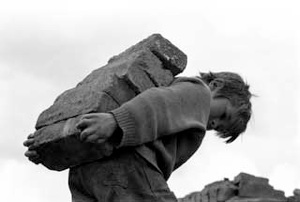
In 1965, Jorge met Martha Rodriguez, who had recently returned from France, where she had studied filmmaking and anthropology. They decided to work together on a documentary film on child exploitation in the "Chircales" (artisan brick factories) in the neighborhood of "Tunjuelito," south of Bogota. As a photographer, he always paid special attention to the treatment of the image in this documentary. During this period, Jorge was studying with the photographer Hernando Oliveiros, where Jorge had the opportunity to deepen his knowledge of the craft. "Chircales" soon became a classic of the New Latin American Cinema. Its International recognition allowed Martha and Jorge to continue their documentary work.
Between 1966 and 1986 he created his major photographic series and built a large archive of pictures that have become the testimony of their documentaries work process.
Some of the films that Jorge Silva and Martha Rodriguez made together are:
1972 "Planas, testimonio de un etnicidio," (Plains, Testimony of an Ethnocide)
1975 "Campesinos," (Peasants)
1982 "Nuestra Voz de Tierra, Memoria y Futuro," (Voice of Earth, Memory and Future.)
1987 "Nacer De Nuevo," (To Be Born Again.)
1989 "Amor, Mujeres y Flores," (Love, Women and Flowers.)
These documentaries focus on subjects such as the agrarian movement; indigenous lands reclamations, massacres of indigenous communities and peasants, as well as the environmental problems inside the Colombian flower industry. In addition, he left an extensive photographic archive concerning the Colombian political situation in Colombia during his time, urban and rural social movements, architecture, artists, family and friends. Jorge left unfinished projects in collaboration with the writer Arturo Alape. Together they worked on the scripts for three fiction movies about the history of the political violence in Colombia.
Jorge died unexpectedly at dawn on January 28, 1987, at 46 years old, after an illness caused by a duodenal ulcer.



















Add your information (With the self-presentation files)
Convention with Wikiafrica / Wikipedia : Southplanet's contents are shared for free according to the licence Creative commons  .
.
© Some artistic content (photos, videos, sound recordings, written texts) is subject to copyright. Copyright is mentioned when and where it applies. Copyrighted material cannot be reproduced.