




Articles
33 files


Malek Bensmaïl is an Algerian director and screenwriter, born in 1966 in Constantine. Primarily devoted to creative documentary filmmaking, his work explores Algerian history and society through questions of memory, transmission, identity and democracy. He favours close observation of individuals and institutions, paying particular attention to the contradictions of everyday life and to voices that fall outside official narratives.
He began making Super 8 films at a very young age and won Algeria's first national prize for amateur filmmaking. After studying cinema in Paris, he completed his training with an internship at the Lenfilm studios in Saint Petersburg. He subsequently developed a body of work encompassing documentary, video art, historical investigation and fiction.
In 1996, he directed "Territoire(s)", an essay film combining archival footage, propaganda films, fiction excerpts and documentary images to examine representations of violence in Algeria, the Arab world and the West. The film received several awards, including the prize for best documentary discovery at Montreal's Festival du nouveau cinéma. With "Algerian TV Show", made for Canal+, he explored, between documentary and fiction, Algerians' relationship with television and the forms of self-mockery generated by the audiovisual landscape.
In 1998, "DéciBled" examined the diversity of Algerian music and the experiences of musicians in exile. Looking beyond the international prominence of raï, the film brought together musical creation, resistance and political engagement.
With "Boudiaf, un espoir assassiné", made in 1999, he retraced the career of Mohamed Boudiaf, who was recalled to lead the Algerian state after a long exile and assassinated in June 1992. This work opened a series of investigations into the exercise of power and the political crises of contemporary Algeria.
In "Des vacances malgré tout", made in 2000, he followed an Algerian family living in France as they returned to spend the summer in a house built gradually over many years in their home country. Through this family chronicle, he observed the differences between those who had left and those who had stayed, the expectations surrounding a return home and the contradictions of belonging. The film received the Heritage Award at the Cinéma du réel festival.
In the early 2000s, he also directed "Dêmokratia", a short fiction film freely inspired by Rachid Mimouni's novel "Une peine à vivre". This fable about dictatorship and the mechanisms of absolute power reflected an interest in fiction that runs throughout his career. With "Plaisirs d'eau, les bains de ce monde flottant", he turned his attention to communal bathing practices and their relationship with the body, intimacy and social life in several countries.
With journalist Thierry Leclère, he co-directed "Algérie(s)", a two-part documentary investigation into the violence of the 1990s. Drawing on archives and interviews with political and military leaders, Islamists and representatives of civil society, the film sought to understand the processes that had led the country into internal conflict.
In 2004, "Aliénations" marked an important stage in his work. Filmed in a psychiatric department in Constantine, it followed patients, their relatives and their caregivers. Paying tribute to his psychiatrist father, Bensmaïl approached mental suffering in its individual, family, social and political dimensions. The documentary received, among other distinctions, the Libraries Award at Cinéma du réel and the Magnolia Award for best documentary in Shanghai.
In "Le Grand Jeu", made in 2005, he observed the mechanisms of political competition through Algeria's 2004 presidential campaign. The film, which examined the construction of an opposition and the limits of pluralism, encountered obstacles to its broadcast in both France and Algeria.
Made in 2008 and released theatrically in France in 2010, "La Chine est encore loin" is set in Ghassira, in the Aurès region, near the place where some of the first civilian victims of the war of independence were killed. Following the everyday life of a school and local residents, the filmmaker examined the transmission of knowledge, the place of languages and the relationship between national memory and daily experience. The film received the Jury Prize at Nantes' Festival des 3 Continents and the Grand Prize at Munich's documentary festival.
Bensmaïl was also awarded a residency at Villa Kujoyama in Kyoto to develop his fiction feature project "Odysseys". In 2010, he co-founded the production company Hikayet Films in Constantine with producer Hachemi Zertal.
With "Guerres secrètes du FLN en France", he revisited the role of the French Federation of the National Liberation Front during the war of independence, the opening of a second front on French territory and the confrontation between the FLN and the Algerian National Movement. In 2012, he co-directed "1962, de l'Algérie française à l'Algérie algérienne" with Marie Colonna, examining the transition from colonial rule to independence. That same year, France's Institut national de l'audiovisuel released a box set of several of his films entitled "Malek Bensmaïl, un regard sur l'Algérie d'aujourd'hui".
In 2013, he made "Ulysse, le brûleur de frontières et la mer blanche du milieu" for the exhibition "Méditerranées", as part of Marseille-Provence's programme as European Capital of Culture. Conceived as a journey around the Mediterranean basin, this film installation examined movement, borders and the political, economic and social transformations of the region.
With "Contre-Pouvoirs", which had its world premiere at the Locarno Film Festival in 2015, he immersed himself in the newsroom of the independent daily El Watan during the 2014 presidential campaign. Rather than focusing solely on the electoral process, the film observed how news was produced, the discussions between journalists and the practical conditions under which an independent press operates.
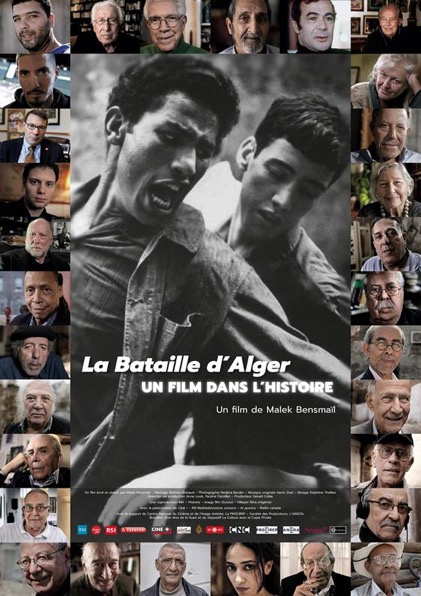
In 2017, he directed "La Bataille d'Alger, un film dans l'Histoire". Through archives and interviews, he revisited the making of Gillo Pontecorvo's film, its directorial choices, its political uses and its international reception. The documentary examined how a cinematic work contributes to the construction and circulation of historical memory.
In 2020, Bensmaïl became a member of the Academy of Motion Picture Arts and Sciences, the institution that presents the Oscars. Alongside his filmmaking, he takes part in discussions, masterclasses and workshops devoted to documentary cinema.
Broadcast on Arte in 2021, "Toute l'Algérie du monde" analysed the country's place on the international stage, from the Black Decade to the Hirak movement and the fall of Abdelaziz Bouteflika. The film connected domestic political transformations with economic resources, security issues and Algeria's diplomatic choices.
In 2026, he directed his first fiction feature, "L'Arabe", freely adapted from Kamel Daoud's novel "Meursault, contre-enquête", from a screenplay co-written with Jacques Fieschi. Set in Algeria during the Black Decade, it follows a journalist who meets a man in Oran claiming to be the brother of the "Arab" killed in Albert Camus's "The Stranger". Featuring Ahmed Benaïssa, Hiam Abbass, Dali Benssalah and Nabil Asli, the film brings together colonial memory, the erasure of identities and contemporary violence. Presented at the International Film Festival Rotterdam, it opened in French cinemas on 4 November 2026. This move into feature-length fiction extends the questions running through his documentary work about the possibility of naming, transmitting and recounting Algerian history.
26 files
2 files
52 files
33 files
















Add your information (With the self-presentation files)
Convention with Wikiafrica / Wikipedia : Southplanet's contents are shared for free according to the licence Creative commons  .
© Some artistic content (photos, videos, sound recordings, written texts) is subject to copyright. Copyright is mentioned when and where it applies. Copyrighted material cannot be reproduced.

